

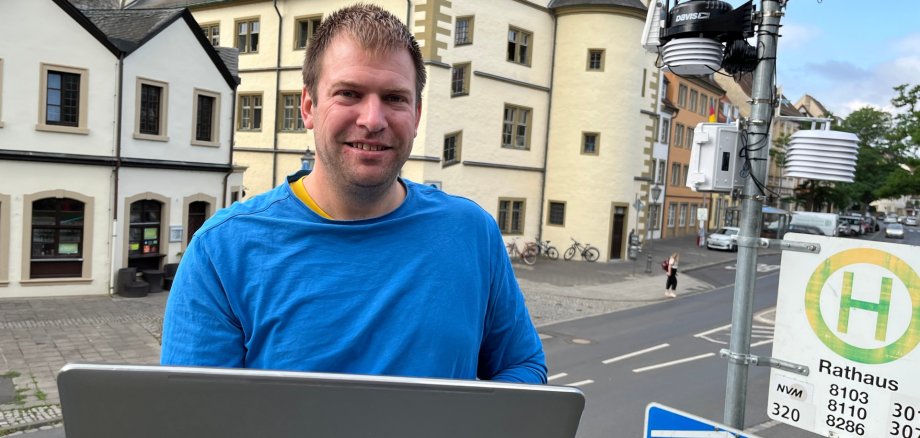
The town of Kitzingen and the University of Würzburg are working together on an urban climate project. One important goal is to measure the so-called urban climate effect. This describes how much cities heat up in comparison to the surrounding area due to the building fabric. Four weather stations were set up for this purpose on Thursday 17 July at various locations in the city.
These measurements have already taken place in Würzburg from 2018 to 2022. A new research project at the University of Würzburg is now also dedicated to this task in various towns and municipalities in the district of Kitzingen. The large district town is of particular importance, as project manager Christian von der Stein-Hartmann from the University of Würzburg explains: "As one of the heat hotspots in the whole of Germany, Kitzingen plays a pioneering role". Here, it is already possible to observe what the weather will be like in many other regions of Germany in ten to fifteen years' time.
A weather station has been set up at Platz der Partnerstädte, Glauberstrasse, Wörthstrasse and Eselsberg. In addition, a number of temperature and soil moisture sensors were installed in Kaiserstrasse in order to monitor the trees selected there over a longer period of time. "It would be interesting to know to what extent the microclimate changes as a result of the remodelling and the newly planted trees, especially if the Kaiserstraße is remodelled," explains climate protection manager Martin Schneider, who is coordinating the work for the city of Kitzingen.
The Kitzingen research project will be based on the Würzburg experimental setup. "However, instead of measuring the ecosystem performance of the trees, measurements of soil moisture and soil temperature will be carried out where possible," reports von der Stein-Hartmann.
In addition to temperature and humidity, the four weather stations also measure wind speed, precipitation, solar radiation and air pressure every 10 minutes. This data is sent to a portal in real time. "This allows us to analyse the heat load for the residents," says Martin Schneider. The data will by no means be analysed behind closed doors, but will be publicly accessible to every citizen in a few days' time.
In addition, the soil temperature and soil moisture are measured at two layer depths (30 and 100 centimetres) from Königsplatz to the Old Main Bridge. This is also valuable data in dry Kitzingen. "It can be used, for example, to make statements about the water availability of urban greenery," says von der Stein-Hartmann. He hopes that the series of measurements, which will initially run for two years and involve municipalities from Volkach to Wiesentheid to Marktbreit, will provide valuable data to answer pressing questions: What cooling effect does the River Main have? Where are there air corridors that can transport cool winds into the city even when it is very hot? When do the trees and plants in the city need how much water? Ultimately, all this data provides current and future urban planners with valuable recommendations for action. "So that life in Kitzingen will still be worth living in the distant future," says Schneider.