

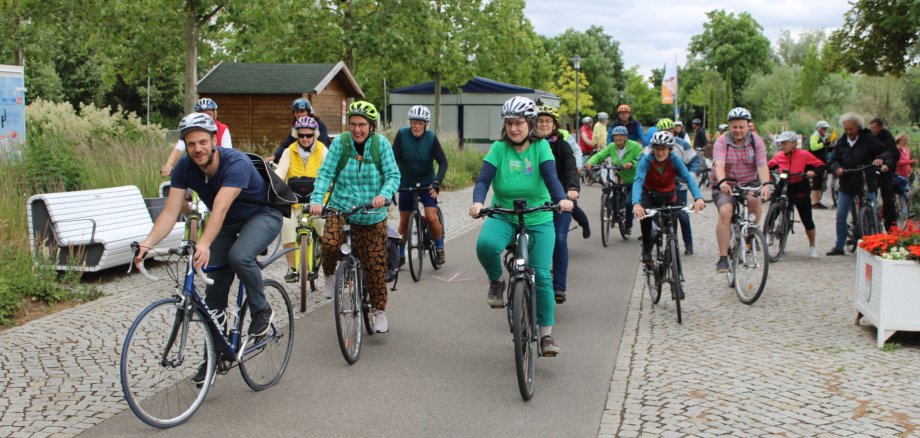
The third Kitzingen city cycling event was organised in cooperation with the district of Kitzingen. Cycling took place from 27/06/2025 to 17/07/2025. After one week, we have almost 150 active cyclists and over 10,000 kilometres cycled. A new record for kilometres cycled could therefore be set. The award ceremony will take place after the summer holidays.
The first Kitzingen city cycling event took place from 23/06/2023 to 13/07/2023. Almost 180 people took part. In addition to the tracking within the three-week period, journeys by people who took part in another city cycling event (e.g. Dettelbach, Volkach, Würzburg) and cycled through the Kitzingen city area were also recorded. A total of 34,808 kilometres were recorded for the city of Kitzingen in 5138 journeys by 444 people.
The second Kitzingen city cycling event took place from 24/06/2024 to 14/07/2024. In contrast to the first city cycling event, this one was less advertised and started without a kick-off event. Almost 140 people took part. A total of 346 people were registered with a recorded distance of 22,775 km. The second city cycling event was repeatedly interrupted by rainy days, which was directly reflected in the number of kilometres cycled on the rainy days.
Year | Number of recorded journeys | Recorded distance in [km] | Number of persons recorded |
| 2025 | 6.942 | 42.330 | 192 |
2024 | 2.545 | 22.775 | 346 |
2023 | 5.138 | 34.808 | 444 |
What happens to the data?
These two data sets were analysed. The data was analysed by looking at the number of people travelling on the individual routes, the speed, the waiting times, the time and the day of the week. This data is used for further cycle path planning (e.g. the planned cycle path to Kaltensondheim). Based on the data, we can clearly demonstrate the urgency of a dedicated cycle path to Kaltensondheim, as this is indicated by the number of kilometres cycled to this location in comparison with the other villages. This creates a reliable basis for further planning. Particularly where major structural changes are due in the next few years (Kaiserstrasse, railway station, etc.), we can identify the most favourable routes based on the flow of cyclists. Another aim is to use the routes travelled to make schools in the city safer for cyclists. This data will therefore be used proactively over the next few years whenever changes are made to the cycling network.
We would like to thank all participants for their great commitment.