Diese Seite wurde automatisch übersetzt. Es kann daher zu Abweichungen oder Ungenauigkeiten im Text kommen. Verbindlich ist ausschließlich die Originalfassung. Rechtsansprüche aus Inhalten der übersetzten Version sind ausgeschlossen.
Häcker Chronicle
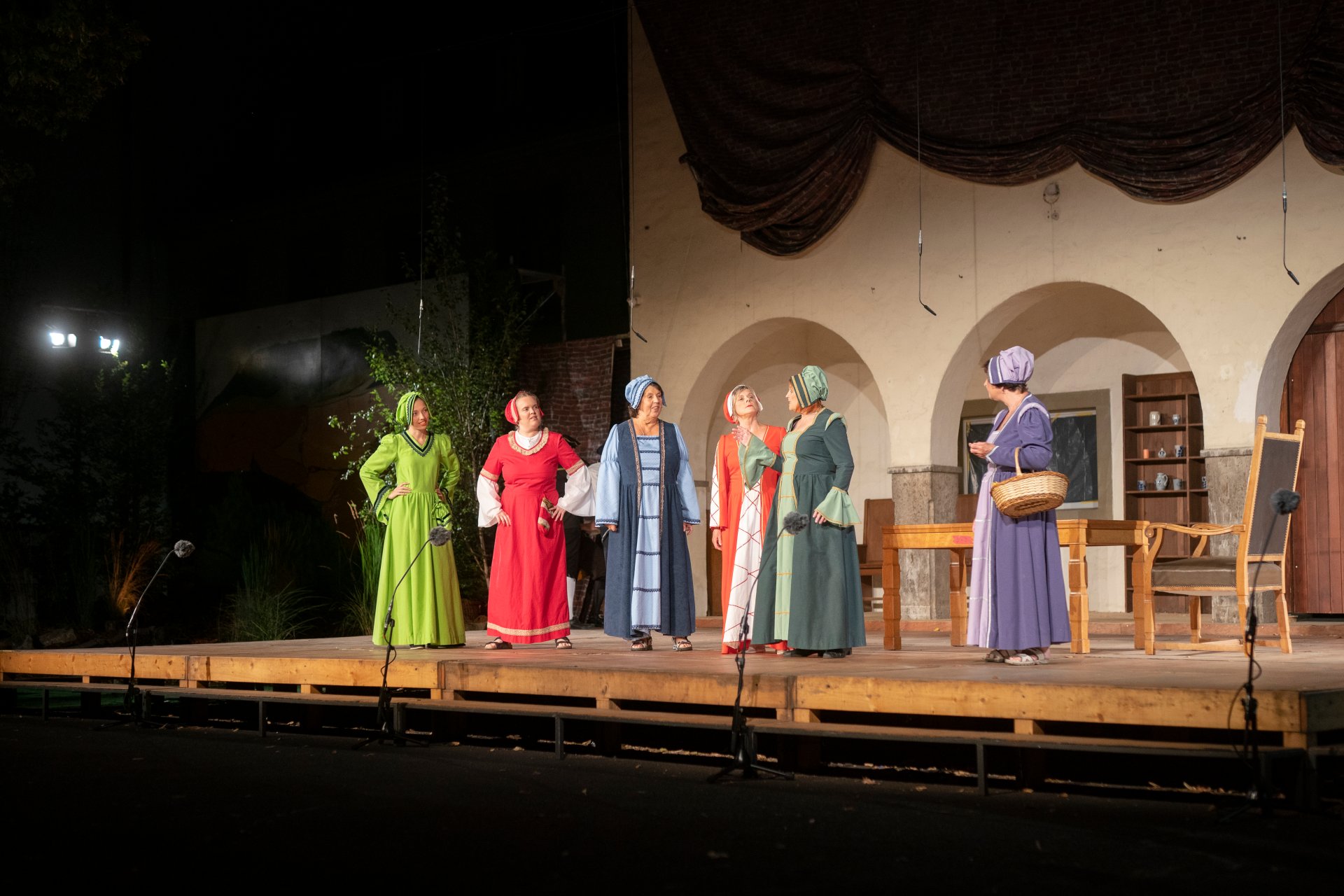
In a total of 13 acts, the history of the town comes to life - from its foundation in 745 to the 20th century, when the garrison town of Kitzingen was also known as "Little Las Vegas" thanks to its many bars and live music. The town's history is staged in a 3.5-hour festival in the inner courtyard of the Friedrich-Bernbeck-Schule. Anyone with a passion for history and who enjoys open-air performances should not miss this spectacle. The performance only takes place every 5 years.
Local poet Engelbert Bach wrote the Häcker Chronicle shortly after the Second World War, with the support of Rudolf Cyperrek, Hanns Rupp and Dr Fritz Sturm. It was first performed in 1951, to mark the town’s 1200th anniversary. After that, there was a long hiatus. In the late 1970s, the then town council launched a new attempt to revive the Häcker Chronicle.
The history of the Häcker Chronicle
According to legend, Kitzingen was founded by Hadeloga, the daughter of King Pippin, in the year 745. On a stormy night, she threw her veil from the nearby Schwanberg out into the dark night and a monastery was to be built where it was found. The shepherd Kitzo found the veil and Hadeloga honoured her vow. This scene is impressively depicted when Hadeloga, on horseback and looking far ahead, predicts the future of Kitzingen.
There was great joy when the village of Kitzingen was elevated to the status of a town, as this also brought considerable financial benefits. This event and the ambivalent reactions of the citizens are captured in the film.
Kitzingen has been home to important people in its long history. Elisabeth of Thuringia, for example, found refuge from the persecution of her brother-in-law in the monastery. Hedwig of Andechs, later known as "St Hedwig", was educated in the Benedictine convent in Kitzingen and married Henry I, Duke of Silesia and Poland.
Florian Geyer, the Franconian peasant leader, recruited his troops in Kitzingen and brought great suffering to the town.
Kitzingen's landmark is a leaning tower. Legend has it that in 1471, the year the tower was built, it was a very dry summer and instead of the lack of water, the abundance of wine was used to build the walls. This event is impressively and comprehensibly depicted.
For a long time, Kitzingen did not have its own town hall and had to rely on the favour of the abbess of the Benedictine convent, who graciously provided a room in a wooden barrack on the convent grounds. It was not until 1563, after lengthy negotiations, that the town hall was inaugurated.
The 30 Years' War was not without consequences for the town and brought it to the brink of ruin. The shrewdness of the Kitzingen councillors, coupled with wine, saved the town and its population from the worst.
The history of Kitzingen has also been honoured in recent times. The 50 DM note featured the outline of the Chapel of the Cross, which was built by Balthasar Neumann and consecrated in 1745 by the Prince-Bishop of Würzburg, Carl-Friedrich von Schönborn, with a large proportion of the population of Kitzingen in attendance.
Another event in the town's history was the construction of the railway in 1865, when Kitzingen's rank boatmen feared for their livelihood as the railway would paralyse transport on the Main. A fierce dispute broke out between rank boatmen and supporters of the railway.
Shortly before the end of the war, Kitzingen, like many other towns in Germany, was almost completely destroyed by bombs. One scene in the Häcker Chronicle tells the story in a moving way. But the reconstruction and the achievements up to the present day are also honoured in this historical play.
The arrival of the Americans at the end of the war and the infamous bars in Kitzingen, which GI veterans in America still talk about today, as well as the withdrawal of the Americans in 2006, are also depicted in the Häcker Chronicle of Kitzingen.