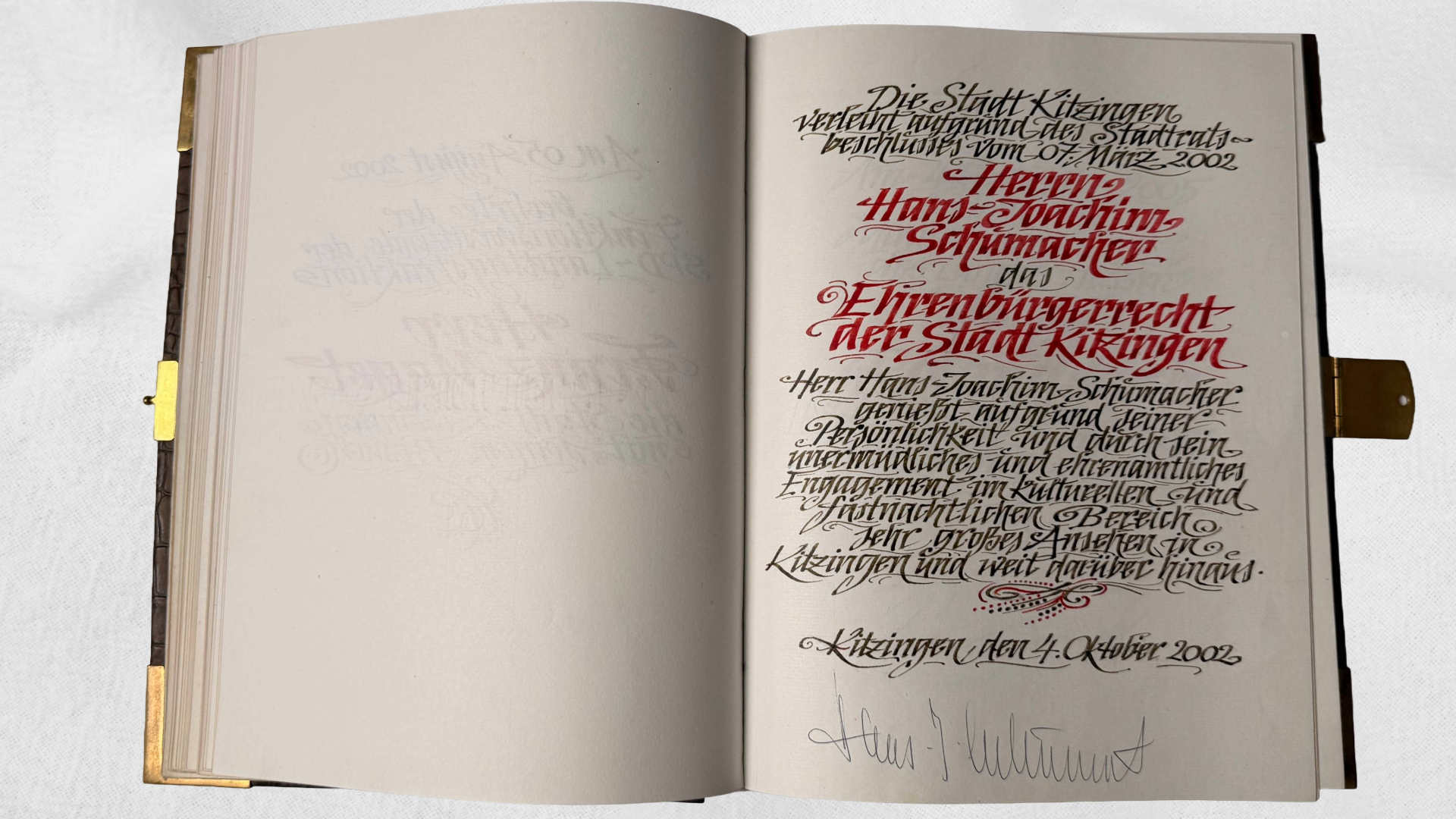
Entry on honorary citizen Hans Joachim Schuhmacher in the Golden Book of the town of Kitzingen.
Diese Seite wurde automatisch übersetzt. Es kann daher zu Abweichungen oder Ungenauigkeiten im Text kommen. Verbindlich ist ausschließlich die Originalfassung. Rechtsansprüche aus Inhalten der übersetzten Version sind ausgeschlossen.

Honorary citizen of the town of Kitzingen

Honorary citizenship is the highest honour that the town of Kitzingen can bestow on living persons. It can only be awarded if the person to be honoured has rendered outstanding services to the town of Kitzingen. This is the case if they have decisively influenced the development of the town through selfless public work and promoted the welfare of the citizens. The services of the person to be honoured must have directly benefited the town of Kitzingen.

Honorary citizenship is conferred by the Lord Mayor on the basis of a City Council resolution at a City Council meeting. The award is made by handing out an honorary citizenship letter and by entry in the book of honorary citizens.

The right to nominate candidates for the award of honorary citizenship lies exclusively with the Lord Mayor and the members of the City Council.

  • Karl Anton Axt (1 June 1837)

    *12 November 1783 in Marktheidenfeld, † 13 July 1852 in Kitzingen

    Axt had been a legally qualified councillor of the town since 1818. From 1845 to 1850, he held the office of mayor of Kitzingen. He was also the hospital administrator in Kitzingen.

    The honorary citizenship was awarded for special services in the care and nursing of the poor, elderly and sick.

  • Karl Friedrich Ulrich (1 June 1837)

    *20 July 1791

    Ulrich was town clerk of the town of Kitzingen from 1818. From 1839 to 1845 he was mayor.

    Awarded honorary citizenship for his commitment to the economy. During his term of office, the first municipal savings bank was opened and the trade on the River Main was expanded.

  • Albert Welz (1 June 1837)

    *4 April 1768 in Mellrichstadt, † 13 August 1838 in Kitzingen

    Albert Welz was mayor of Kitzingen from 1818 to 1827, after which he became town treasurer.

  • Dr Friedrich Anton Reuß (19 February 1840)

    *18 September 1810 in Kitzingen, † 4 March 1868 in Nuremberg

    Reuß studied medicine, philosophy, archaeology and Old German languages. He habilitated in Würzburg in 1850 and was appointed Professor of Old German.

    He was awarded honorary citizenship for voluntarily sorting through the city's disorganised archives and saving numerous historical writings, documents and letters.

  • Joseph Feller (25 August 1841)

    Feller was a district judge in Kitzingen. He earned his honorary citizenship through "a long life in harmony with the royal officials". In administrative and judicial matters, they did everything that was "for the benefit and piety of the town" (see file no. VII/A/3/1 (old) box 224).

  • Dr Joachim Albert Lotz (25 August 1841)

    Lotz was a rent officer. Together with Joseph Feller, he was awarded honorary citizenship for "a long life in harmony with the royal officials". He rendered outstanding services by maintaining good relations between the state and the city.

  • Dr Anton Ruland (5 November 1862)

    *25 November 1809 in Würzburg, † 8 January 1847 in Munich from cholera

    Ruland was a doctor of theology and worked as a chaplain in Kitzingen, among other things.

    His honorary citizenship was granted by King Maximilian in 1862 for his services as a member of parliament for the railway line.

  • Dr Michael Henke (18 June 1883)

    *27 March 1802 in Kitzingen, † 9 December 1885

    Henker studied medicine in Würzburg and became a district doctor after completing his physics degree in 1854. On the occasion of his 50th anniversary of service, Henke is awarded honorary citizenship. He is also awarded the "Golden Medal of Honour of the Order of Ludwig" by King Ludwig II of Bavaria.

  • Prince Otto von Bismarck (28 February 1895)

    *1 April 1815 in Schönhausen, † 30 July 1898 in Friedrichsruh

    Bismarck was Prussian Prime Minister and Foreign Minister from 1862. He was Federal Chancellor from 1867. On his initiative, the North German Confederation was expanded by the annexation of the southern German states to form the German Empire. Bismarck was appointed Imperial Chancellor under the German Emperor Wilhelm I.

    He was made an honorary citizen of the town of Kitzingen on his 80th birthday. A street in Kitzingen is also named after him.

  • Ferdinand Sertorius (17 January 1906)

    *30 December 1839 in Neuendettelsau, † 1 December 1907 in Kitzingen

    After studying law, Sertorius became mayor of Roth am Sand. After being a legal councillor in Kaufbeuren and mayor in Kronach, he was elected mayor of the town of Kitzingen in 1882. He held this office until his death in 1907.

    He was awarded honorary citizenship for his services to the development and well-being of the city.

  • Friedrich von Deuster (17 January 1906)

    *2 March 1836 in Kitzingen, † 1 October in Ditterswald

    Von Deuster was a district councillor and a member of the municipal council until 1908.

    He was made an honorary citizen for his commitment to the community. He advocated the promotion of industry and commerce and was instrumental in Kitzingen's transformation into a garrison town.

  • Dr Wilhelm Schuster (10 February 1924)

    *1 February 1854 in Neuburg, † 22 May 1929 in Kitzingen

    Schuster worked as a doctor in Kitzingen. In 1881, he was appointed head of the municipal hospital. Until his resignation in autumn 1927, Schuster had not taken a single day off. He was awarded the title of Royal Court Councillor for his work as doctor to the district command.

    He was awarded honorary citizenship in recognition of his self-sacrifice and selfless devotion to duty.

  • Paul von Hindenburg (2 October 1927)

    *2 October 1847, 2 August 1934

    Hindenburg was leader of the 8th Army in the First World War and victor of the famous Battle of Tannenberg. From 1914, he was Field Marshal General and was elected President of the Reich in 1925. Hindenburg was able to prevail again in a run-off election against Hitler in 1932.

    On his 80th birthday, Hindenburg was made an honorary citizen of the town of Kitzingen. In the course of this, it was also decided to rename the "Glacisstraße" as "Hindenburgring".

  • Dr Otto Helmuth (2 May 1934, revoked in May 1945)

    *22 July 1896 in Markt Einersheim, † 1967 in Reutlingen

    Helmuth was initially a dentist in Markt Einersheim before becoming Gauleiter of Mainfranken in 1926. Helmuth was regarded as a figurehead of the NSDAP in Franconia. He was awarded honorary citizenship for the "revival of the Main-Franconian region".

    After the Second World War, he was stripped of his honorary citizenship in May 1945.

  • Adolf Hitler (26 April 1933, revoked in May 1945)

    *20 April 1889 in Braunau, † May 1945

    Hitler was appointed Reich Chancellor by Hindenburg in 1933. After Hindenburg's death, he also held the office of Reich President. He triggered the Second World War with the invasion of Poland.

    As in many German cities, Hitler was also made an honorary citizen of Kitzingen. In 1945, he was stripped of his honorary citizenship on the basis of Art. 21 Para. 2 of the "German Municipal Code".

  • Siegfried Wilke (24 April 1961, revoked in October 2021)

    *24 April 1891 in Hellmitzheim, † 5 December 1969 in Kitzingen

    After Schuster's death in 1930, the law graduate was elected as the new mayor of the town. Under his initiative, the construction of the new Main Bridge was initiated and the conditions for the housing estate were created. By surrendering the town without a fight in 1945, he prevented further destruction. Numerous other projects such as the expansion of the Main into a major shipping route, the creation of the new cemetery and the remodelling of the Old Main Bridge can be traced back to Wilke.

    He was awarded the Federal Cross of Merit 1st Class in 1956 and was made an honorary citizen of the town of Kitzingen on his 70th birthday in 1961.

    Due to new findings about Siegfried Wilke's work under National Socialism, he was posthumously stripped of his honorary citizenship in October 2021.

  • Rudolf Schardt (31 October 1991)

    *5 September 1927 in Kitzingen, † 15 October 2019 in Kitzingen

    Schardt studied law and political science in Würzburg. From 1958, Schardt held the office of legal councillor for the town of Kitzingen. He was mayor of Kitzingen from 1967 to 1991. During his term of office, four districts were incorporated, a new traffic concept was developed and wastewater disposal and treatment was a focus of his work.

    On his retirement as Lord Mayor, he was made an honorary citizen of the town of Kitzingen. He also received the Federal Cross of Merit 1st Class. As the creator of the German-Italian partnership, he also received honorary citizenship in Kitzingen's twin town of Montevarchi.

  • Massimo Gregorini (18 June 1994)

    Gregorini was mayor of the Italian twin town until 1993. He became the third honorary citizen of the town of Kitzingen after 1945.

    Gregorini was the first foreigner to be awarded honorary citizenship for his special services to the town twinning with the city of Kitzingen.

  • Hans-Joachim Schumacher (4 October 2002)

    *4 February 1926, † 31 October 2017

    Schumacher worked as a teacher and later rector in the estate. He was appointed to various positions by the government of Lower Franconia. Schumacher was president of the Kitzingen Carnival Society, which he co-founded, until 1985. He was also active on the board of the German Carnival Association and as director of the German Carnival Museum.

    He was awarded honorary citizenship of the town of Kitzingen for his "tireless and voluntary commitment to culture and carnival".

Help with accessibility

  • General

    We endeavour to make our website accessible. You can find details on this in our accessibility statement. You can send us suggestions for improvement via our feedback form Report accessibility.

  • Font size

    To adjust the font size, please use the following key combinations:

    Larger

    command
    +

    Smaller

    command

    Larger

    Ctrl
    +

    Smaller

    Ctrl
  • Keyboard navigation

    Use TAB and SHIFT + TAB to navigate through next/previous links, form elements, and buttons.

    Use ENTER to open links and interact with elements.

  • Contrast mode

    Press the following key combination to reduce or increase the contrast:

    Enlarge

    control
    option
    command
    .

    Decrease

    control
    option
    command
    ,
    Note: The shortcuts must be activated in the system settings of the operating system.

    Press the left ALT key + left SHIFT key + PRINT to quickly turn high contrast mode on or off.

  • Invert colours

    Press the following key combination to switch the colour inversion on and off:

    control
    option
    command
    8
    Note: The shortcuts must be activated in the system settings of the operating system.

    First activate the screen magnifier and then switch the colour inversion on and off with the following key combinations:

    1. screen magnifier

    +

    2. invert colours

    Ctrl
    Old
    I
  • Screen magnifier

    Press the following key combinations to use the screen magnifier:

    Switch on/off

    option
    command
    8

    Enlarge view

    option
    command
    =

    Zoom out view

    option
    command
    Note: The shortcuts must be activated in the system settings of the operating system.

    Switch on / Enlarge view

    +

    Zoom out view

Select language