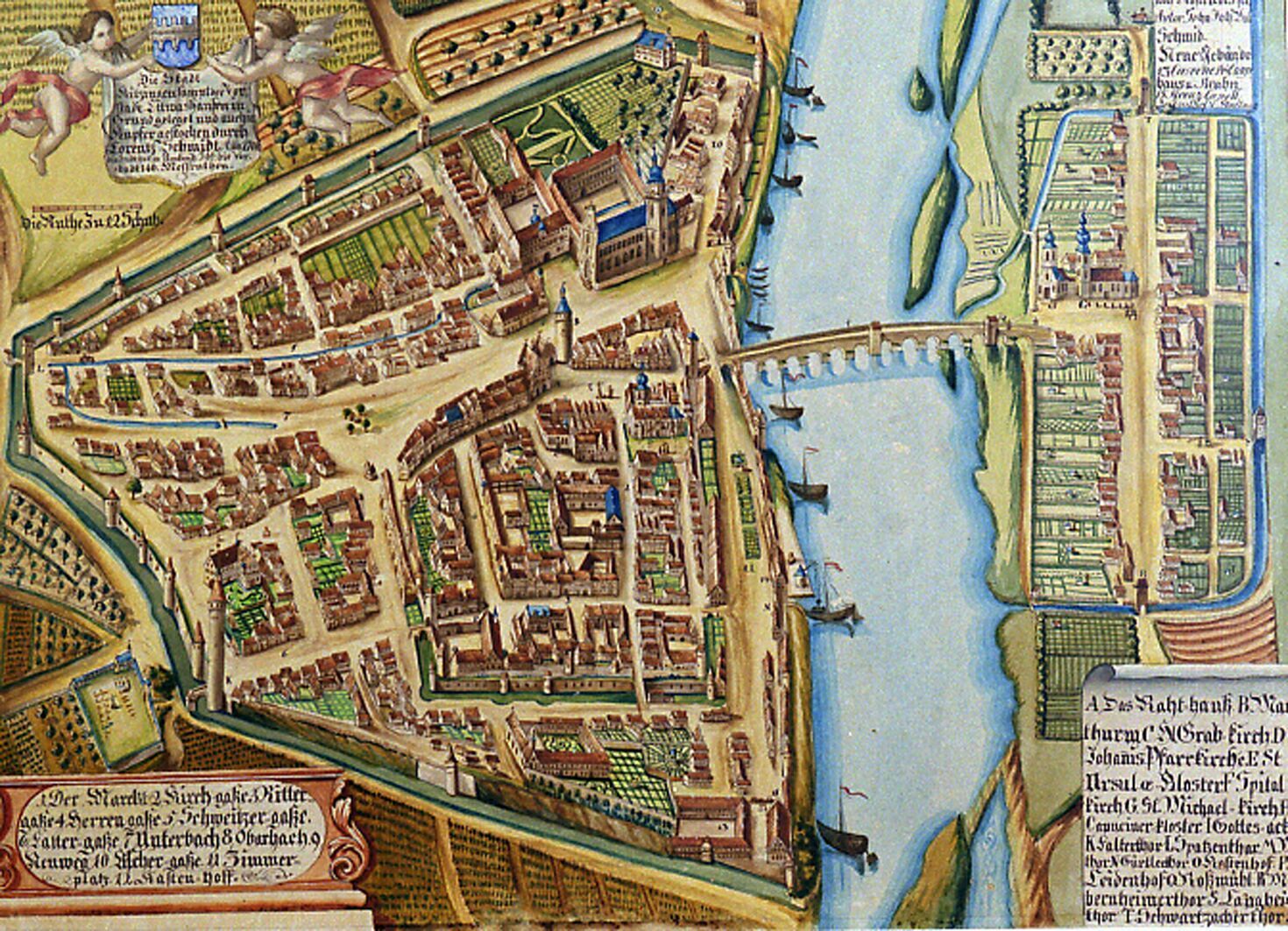
In 1629, Kitzingen once again came under the rule of the Hochstift Würzburg, which resulted in a harsh re-Catholicisation and the emigration of many Protestant citizens. During the Thirty Years' War, the town was again briefly under Protestant influence before the returning Protestants were granted religious freedom in 1650. As a result, important ecclesiastical buildings such as the Capuchin church and the Ursuline convent were built, the church of which was later used by the Protestant community. In the 18th century, Balthasar Neumann, an important master builder, left his mark on the townscape, including the Chapel of the Cross and the Protestant St Michael's Church in Etwashausen. The revolutionary and Napoleonic wars placed a heavy burden on Kitzingen at the end of the 18th and beginning of the 19th century. From 1802, the town became part of Bavaria and, after brief political transitions, remained definitively Bavarian from 1814. The railway connection in 1865 ushered in a phase of urban and economic development. In the late 19th century, important educational and cultural institutions were established, including schools and the synagogue as the centre of the Jewish community.
Early modern times
1629 | Prince-Bishop Adolf von Ehrenberg brings Kitzingen back into the possession of the Prince-Bishopric of Würzburg. The subsequent re-catholicisation forces more than 1000 Protestant citizens, including 20 councillors, to emigrate. |
1631-1634 | Following the occupation of Franconia by King Gustav Adolf of Sweden, Kitzingen briefly comes under Protestant rule again. |
1650 | In a decree of grace, Prince-Bishop Johann Philipp I von Schönborn grants religious freedom to the Protestant citizens who have returned after the end of the Thirty Years' War. A Protestant congregation is formed. |
1652 | Consecration of the Capuchin church. The Capuchin monastery is dissolved in 1828 and serves as a hospital from 1831 to 1902. |
1686-1693 | Construction of the Ursuline convent on the site of the former Benedictine convent. The southern end is formed by the convent church, built to plans by Antonio Petrini and consecrated in 1699. The Ursuline convent was dissolved in 1803 and the Protestant community acquired the church building in 1817. |
1741-1745 | Construction of the Cross Chapel in Etwashausen by Balthasar Neumann. |
1748-1754 | Construction of the Protestant St Michael's Church in Etwashausen according to plans by Balthasar Neumann. |
1792-1815 | During the French Revolutionary Wars and the Napoleonic Wars, Kitzingen is severely affected by numerous quarterings and troop movements. |
1802 | Kitzingen becomes part of the Electorate of Bavaria. The town has 3696 inhabitants at this time. |
1806-1814 | Kitzingen temporarily belongs to the Grand Duchy of Würzburg under Ferdinand of Tuscany and finally becomes Bavarian in 1814. |
1865 | Connection to the railway network (Nuremberg-Würzburg). As part of the city expansion plan, it is decided to break through the city wall to create a new district (Mühlberg) in the south-east. |
1871 | Opening of the trade school, which is merged with the Progymnasium (now Armin-Knab-Gymnasium), which has existed since 1894, in 1924 after being converted into a secondary school (1877). |
1882-1883 | Construction of the synagogue and ritual bath on Landwehrstraße, a religious and cultural centre for the 65 Jewish families now living in Kitzingen. |