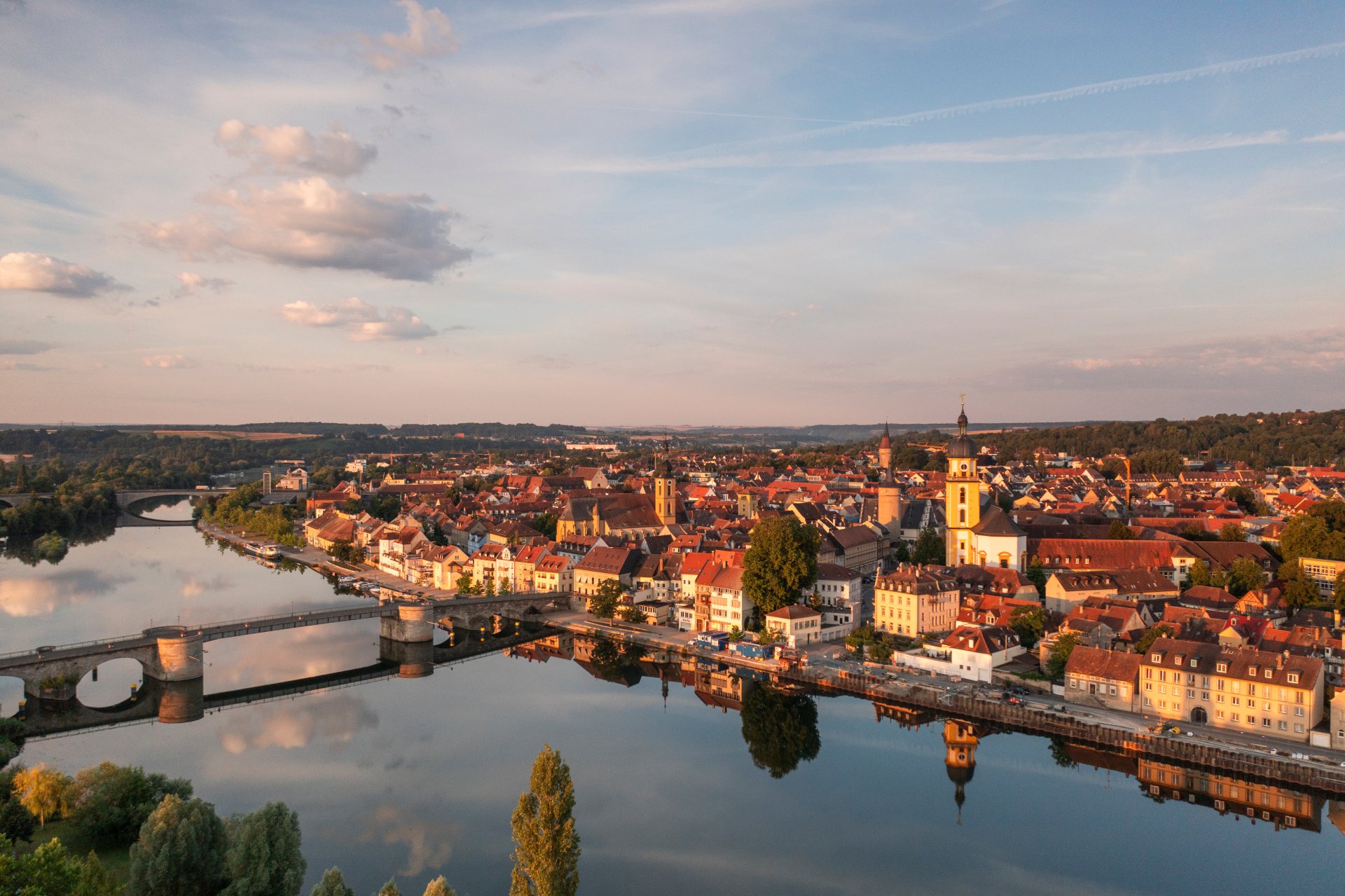
On 1 January 2024, the Heat Planning Act (WPG) came into force in Germany. It provides the legal basis for comprehensive, binding and systematic heat planning. The aim of this Act is to set out, based on local conditions, how the heat supply can be gradually transitioned to renewable energies or unavoidable waste heat. This provides citizens, businesses and energy suppliers with greater planning certainty regarding the future local heat supply.
Municipal heat planning
What is municipal heat planning?
On 1 January 2024, the Heat Planning Act (WPG) came into force in Germany. It provides the legal basis for comprehensive, binding and systematic heat planning. The aim of this Act is to set out, based on local conditions, how the heat supply can be gradually transitioned to renewable energies or unavoidable waste heat. This provides citizens, businesses and energy suppliers with greater planning certainty regarding the future local heat supply.
A key objective of heating planning is to identify the optimal and most cost-effective route to a climate-friendly and forward-looking heating supply. This should be based specifically on the local conditions in Kitzingen.
© Martin Schneider
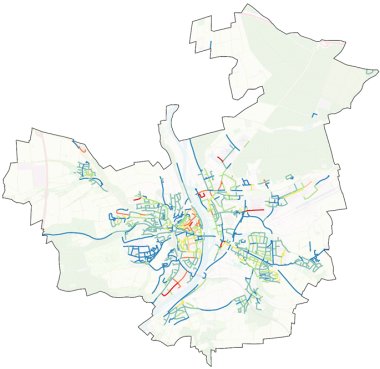
Figure 1 – Heat demand density in the town of Kitzingen: the redder the streets, the greater the heat demand and the more cost-effective a local heating network is likely to be
Municipal heating planning is a key tool for achieving the targets of climate-neutral heating by 2045 in Germany and by 2040 in Bavaria, including in Kitzingen. Municipal heating planning is intended to facilitate the transition to renewable energies, thereby ensuring a long-term and sustainable heat supply that is independent of fossil fuels such as gas and oil. The large district town of Kitzingen has drawn up a municipal heating plan and developed a well-thought-out concept to enable households and commercial premises in Kitzingen to be heated in a climate-neutral manner in future. In addition to climate neutrality, other factors such as environmental impact, independence from geopolitical crises, cost-effectiveness, efficiency and future viability have also been taken into account.
The outcome of the local heating plan
The district town of Kitzingen would like to extend its sincere thanks to all residents for their numerous responses and their interest, to the members of the town council for their support, and to the stakeholders from local businesses, the commercial sector and the housing industry for their expertise and willingness to cooperate. It is only through this broad participation that such a sound basis for planning has been established. Please find attached the full final report on municipal heating planning, together with the comments received:
© Martin Schneider
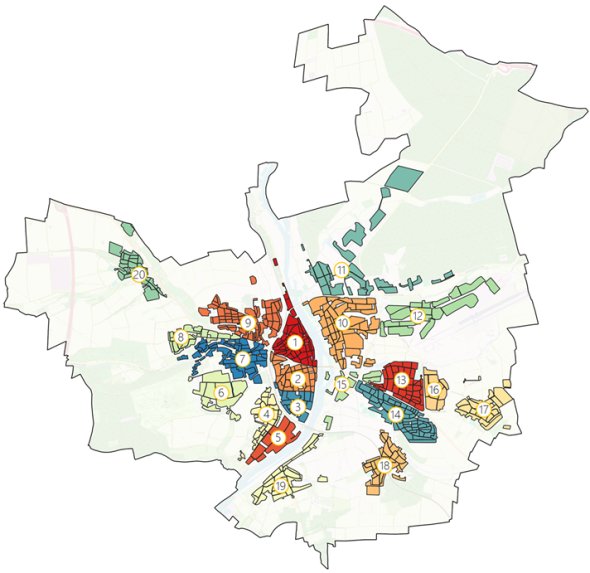
Figure 2 – Division of the urban area into individual neighbourhoods
The urban area has been divided into a total of 20 district heating zones in order to develop bespoke solutions for each individual neighbourhood:
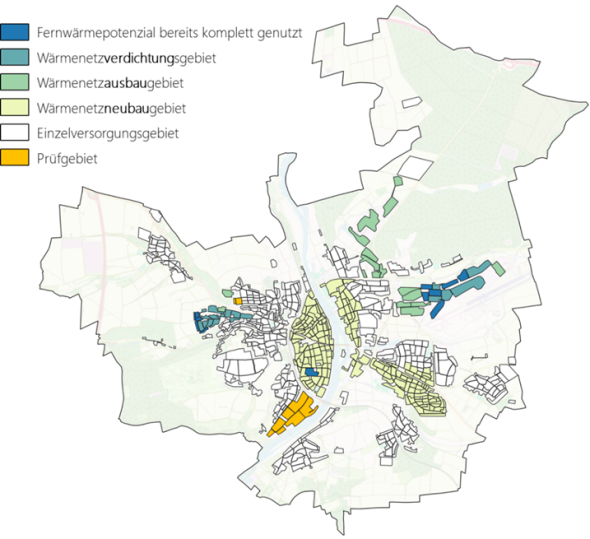
- In areas with high heat demand densities, such as Altstadt, Südstadt Nord, Südstadt Süd, Etwashausen, Siedlung Süd and Siedlung West, the aim is to establish local heating networks.
- In less densely built-up areas or neighbourhoods with low heat demand densities, such as Südweststadt, Innopark, Weststadt, Eselsberg/Keltenstraße, Siedlung Nord, the Goldberg industrial estate, Hoheim, Sickershausen, Hohenfeld and Repperndorf, decentralised solutions are planned.
- The existing local heating networks in Marshall Heights and at Flugplatzstraße/ConneKT are to be retained and expanded.
- The area around the weir is only suitable for a local heating network under certain circumstances and is therefore a special case.
- The Schwarzacher Straße/Am Dreistock residential area is heated via a decentralised system, whilst the industrial estates are to be supplied via a local heating network.
© Martin Schneider
Figure 3 – Areas suitable for district heating networks and individual supply systems
An area profile has been drawn up for each heat supply area. These profiles summarise, across two pages, all the key information about the area, such as heat density, current heat demand, the area’s boundaries and the likely heat supply in 2045. General explanations regarding the supply areas can be found from page 68 onwards. The respective area profiles for the 20 areas are listed from page 127 onwards.
What happens next?
The local heating plan identifies the areas where district heating networks could be a viable option. Whether and how these can be built is now being examined in detailed feasibility studies. These studies look at:
- Technical implementation: Which heat sources are available on site that offer sufficient capacity and quality (e.g. heat pumps, solar thermal, biomass)?
- Legal implementation: What authorisations need to be obtained, what issues need to be taken into account, and how long do the respective procedures take?
- Cost-effectiveness: Is it worth building a network, and if so, under what conditions?
- Funding: What funding is available from the federal government, the federal states and the EU?
- Public interest: A network can only be established if there are enough people interested in connecting to it. That is why providing information to the public at an early stage and involving them in the process is a key component.
Current situation in the Altstadt, Südstadt Süd, Südstadt Nord and Etwashausen neighbourhoods
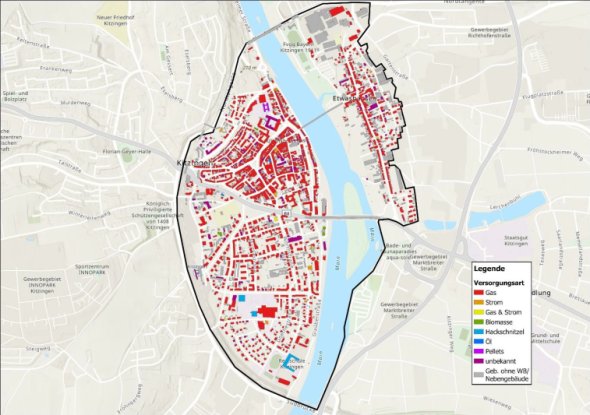
© Martin Schneider
Figure 4 – Gas consumption in the study area
A feasibility study has been carried out for Altstadt, Südstadt Süd, Südstadt Nord and parts of Etwashausen in parallel with the local district heating plan, and has been available since July 2025. The results show that a district heating network is, in principle, feasible. The following details are currently being finalised:
- The proposed heating technologies include two river-water heat pumps, one air-to-water heat pump and a biomass boiler. Their feasibility is currently being assessed.
- Where could the heating plant be located? Several sites are under consideration and are being assessed.
- How can funding be secured?
The focus is currently on planning a local heating scheme for the small area around Kaiserstraße and Königsplatz. The initial results are expected in June.
Please note: It is a long road from feasibility to implementation, one that requires careful planning and can take decades.
Current situation in the Siedlung Süd and Siedlung West neighbourhoods
A feasibility study was carried out for Südstadt South, West and North towards the end of the local district heating planning process. The results will be available shortly: a district heating network is, in principle, feasible. However, this does not apply to the Nordsiedlung, as the demand for heat there is lower due to the higher density of detached houses compared with a higher proportion of blocks of flats. The following details are currently being clarified:
- The planned heating solutions include a connection to the Old Town’s local heating network and a biomass boiler. The feasibility of these options still needs to be assessed.
- Where could the boiler room be located?
- How can funding be secured?
Conclusion
: The town of Kitzingen has taken active steps and is resolutely driving the heating transition forward. The feasibility studies are the next logical step. However, the heating transition will take a long time and is a protracted process. It will take up to 20 years, from detailed planning through securing funding and grants to final implementation. We will keep you informed transparently throughout this process and will get back to you in good time.
FAQ
What does municipal heating planning mean for residents?
There are no immediate obligations for homeowners. Rather, the heating plan provides transparency and guidance:
- Property owners can see whether their building is located within a future district heating network area or whether a decentralised solution would be more appropriate.
- Investments in new heating systems can be planned more effectively.
- Existing heating systems may continue to be operated or repaired.
From 2024, the Building Energy Act (GEG) will require new heating systems to meet the 65 per cent renewable energy target. In areas with district heating networks, a future connection to the network may fulfil this requirement. Any changes to the requirements under the forthcoming Building Modernisation Act can only be incorporated once the Act has been published.
What does ‘decentralised solution’ mean?
In many areas, it is not economically viable to set up a local heating network. ‘Decentralised solutions’ are therefore required. Homeowners must take responsibility for their own heating. Renewable heating systems such as heat pumps, pellet boilers or, as a supplementary measure, solar thermal and photovoltaic systems can be used here.
Are local heating networks ruled out in areas currently designated as decentralised areas?
No. It is still possible to set up (small) privately-owned local heating networks, for example by farmers who can supply heat via biogas plants, etc.
My building is not located in an area where a local heating network may be installed in the future. Can I still connect to a local heating network?
The boundaries of the local district heating planning area have been deliberately drawn in such a way as to ensure economic viability. Individual buildings will most likely not be able to be connected to a local heating network if the distance to the network is too great. If entire streets wish to connect, this will definitely be assessed on a case-by-case basis.
Do I need to replace my heating system?
No, there is no general obligation to replace heating systems under local heating plans. The current requirements of the Building Energy Act are the governing factors in this regard.
Is it true that heat pumps don’t work in older buildings?
No! Modern heat pumps also work in older buildings – provided that: the
radiators are designed for low temperatures (e.g. underfloor heating or a sufficient number of radiators) and
the electrical connection is of sufficient capacity (retrofitting may be necessary).Good insulation of the building envelope improves efficiency: an energy-efficiency refurbishment (e.g. roof or façade insulation) increases the heat pump’s efficiency, but is not strictly necessary.
Does municipal heating planning have an impact on the requirements of the Building Energy Act?
No, the Building Energy Act (GEG) remains in force regardless of the heating plan. The 65 per cent renewable energy requirement will apply from 30 June 2028 at the latest. Local authorities may implement the requirement ahead of schedule as soon as the heating plan has been adopted. In practice, however, this step is often postponed.
Are there any grant schemes for replacing heating systems?
Yes, for example: KfW programmes (low-interest loans) and BAFA grants (direct funding).
Will there be one or more district heating networks in Kitzingen?
District heating networks are particularly cost-effective in areas with high heat density (e.g. many residential buildings, commercial premises or public facilities), low development costs (existing infrastructure or cost-effective installation) and local heat sources such as waste heat, geothermal energy or large-scale heat pumps. They are also particularly suitable in areas with older buildings in need of refurbishment, where individual heating systems are difficult to install.
As part of the local heating plan for Kitzingen, an assessment is currently being carried out to identify which sites meet these criteria. Once the planning process is complete, the designated areas will be communicated transparently.
Our recommendation: Unless you need to replace your heating system urgently, it is worth waiting for the results of the heating planning and feasibility studies. For a personalised energy consultation, please feel free to take advantage of the service offered by Kitzingen District.
Funding through the National Climate Protection Initiative
© Federal Ministry for Economic Affairs & National Climate Protection Initiative
Through the National Climate Protection Initiative, the Federal Government has, since 2008, been launching and supporting numerous projects that help to reduce greenhouse gas emissions. Its programmes and projects cover a broad spectrum of climate protection activities: From the development of long-term strategies to practical support and investment-based funding measures. This diversity ensures a wealth of good ideas. The National Climate Protection Initiative helps to embed climate protection at a local level. It benefits consumers as well as businesses, local authorities and educational institutions.
Funding reference number: 67K25062
Duration of the project: 1 August 2023 to 31 December 2025