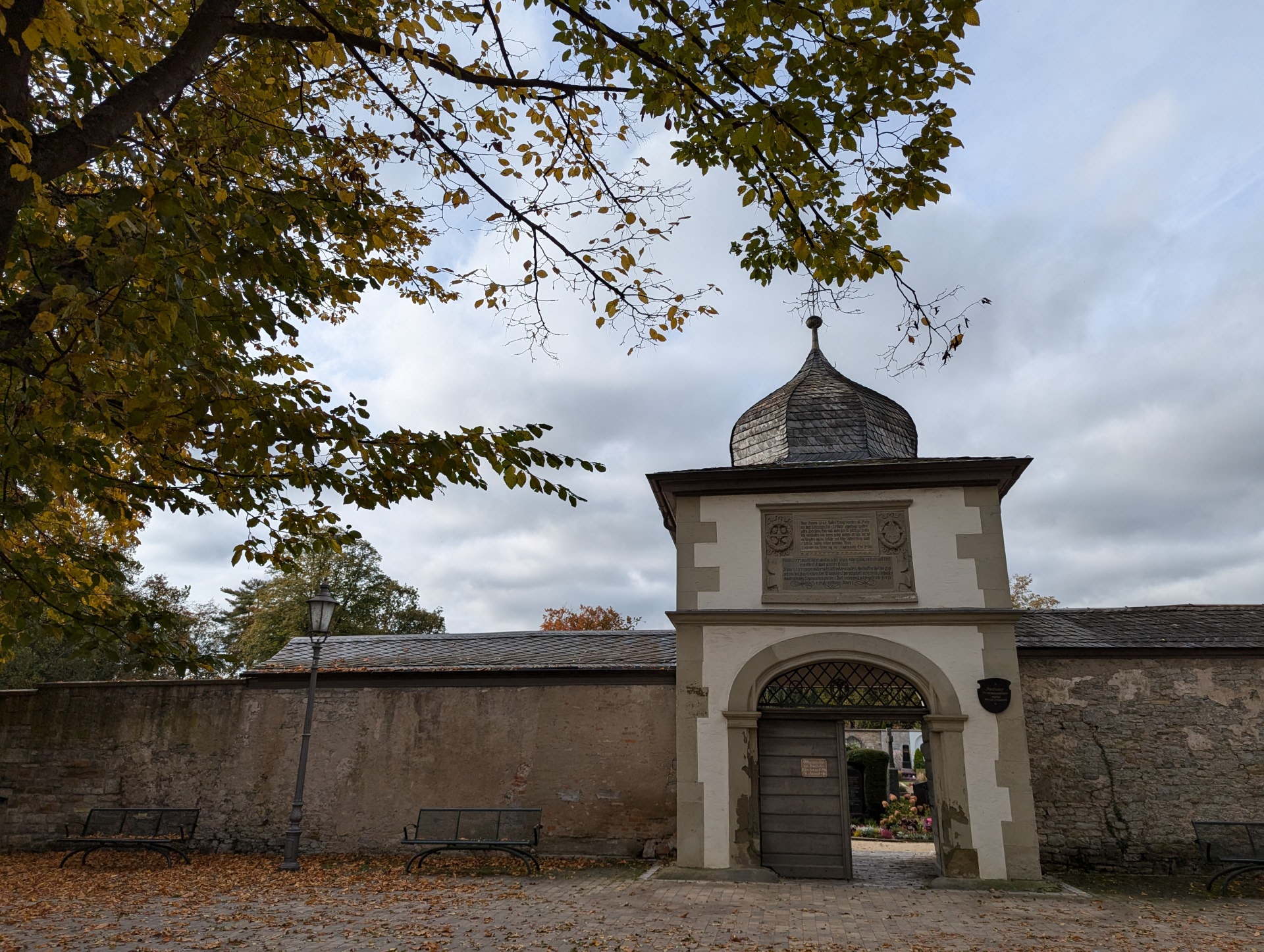
Entrance to the old cemetery
Diese Seite wurde automatisch übersetzt. Es kann daher zu Abweichungen oder Ungenauigkeiten im Text kommen. Verbindlich ist ausschließlich die Originalfassung. Rechtsansprüche aus Inhalten der übersetzten Version sind ausgeschlossen.

Places

Königsplatz

Königsplatz is dominated by an imposing sandstone column, which was erected in 1883 in honour of the Bavarian King Ludwig II (*1845, †1886). Originally, the column was even adorned with a bust of the king.

A special detail on the square is one of the last remaining drinking water fountains in the town. In the Middle Ages, such fountains were indispensable for supplying water to the people of Kitzingen and still tell a piece of the town's history today.

Today, Königsplatz is a central hub in Kitzingen town centre: a total of six streets converge here.

Garden show grounds

Under the motto "Garden City by the River", the Small Garden Show was held in Kitzingen in 2011, which has changed the face of the town forever. The site is now a natural part of the cityscape and is used extensively by residents.

The park runs along the banks of the Main in Etwashausen, with seven different garden areas reflecting the town’s rich horticultural heritage. The newly created ‘Stadtbalkon’ (City Balcony), the showpiece of the garden exhibition grounds, hosts a wide range of activities, including receptions hosted by the town council, concerts and the active ‘Fitness am Stadtbalkonprogramme. In the northern section, several play areas for young and old have been created amidst lush perennial beds. Amidst the colourful flora, there are plenty of cosy spots to sit and relax.

The Friends of the Kitzingen Garden Show Grounds Association maintains the landscaped grounds in a sustainable manner. Thanks to the tremendous dedication of its volunteers, this maintenance work is carried out successfully.

Square of the twin cities

The Town Twinning Square symbolises Kitzingen’s town twinning arrangements with Montevarchi in Italy, Prades in France (both since 1984) and Trebnitz in Poland (since 2009). The square used to be known as Nonnenplatz (Nuns’ Square), as it was once surrounded by a convent. A highlight of the square is the Ludwigsbrunnen, donated by Carl Oskar von Deuster in 1892. He came from the family of Carl Otto II Deuster, one of Kitzingen’s wealthiest families. Carl Oskar von Deuster and his brother Friedrich von Deuster were also the initiators of the redesign of Königsplatz in 1884.

Old cemetery

The Old Cemetery was established in 1542 when the space around the parish church of St John was no longer sufficient for burials. It replaced the former "Gottesacker" and became an important place of remembrance for the town.

A two-storey gate pavilion on the north side provides access to the grounds. Burial sites from the 18th and early 19th centuries still bear witness to the long history of this special place.

US soldiers stationed in Kitzingen until 2006 told the story that Count Dracula's grave can be found at the entrance to the cemetery. This story is still widely circulated in the American media today.

The truth: The grave, richly decorated with skulls and a heaven and hell ceiling relief, is the grave of the Herold family, of whom no descendants exist today.

Gustav-Adolf-Platz (Hadeloga)

The sculpture of Hadeloga here on Gustav Adolf Platz was created by Theophil Steinbrenner. Hadeloga is said to have been a Frankish princess. Her father was King Pippin (sometimes it is also said that she was the daughter of Karl Martell) and resided in the royal castle on the Schwanberg. According to legend, the princess fell in love with the beautiful landscape and wanted to found a monastery here. But where exactly was it to be built?

According to tradition, Hadeloga had her veil thrown into the wind - and where it landed, the women's monastery was to be built. A shepherd named Kitz found the veil and the place was named "Kitzingen" in his honour.

Whether truth or legend - it is certain that a Benedictine monastery was actually founded in Kitzingen in 745, which played an important role in the development of the town. Hadeloga is said to have been the first abbess.

Help with accessibility

  • General

    We endeavour to make our website accessible. You can find details on this in our accessibility statement. You can send us suggestions for improvement via our feedback form Report accessibility.

  • Font size

    To adjust the font size, please use the following key combinations:

    Larger

    command
    +

    Smaller

    command

    Larger

    Ctrl
    +

    Smaller

    Ctrl
  • Keyboard navigation

    Use TAB and SHIFT + TAB to navigate through next/previous links, form elements, and buttons.

    Use ENTER to open links and interact with elements.

  • Contrast mode

    Press the following key combination to reduce or increase the contrast:

    Enlarge

    control
    option
    command
    .

    Decrease

    control
    option
    command
    ,
    Note: The shortcuts must be activated in the system settings of the operating system.

    Press the left ALT key + left SHIFT key + PRINT to quickly turn high contrast mode on or off.

  • Invert colours

    Press the following key combination to switch the colour inversion on and off:

    control
    option
    command
    8
    Note: The shortcuts must be activated in the system settings of the operating system.

    First activate the screen magnifier and then switch the colour inversion on and off with the following key combinations:

    1. screen magnifier

    +

    2. invert colours

    Ctrl
    Old
    I
  • Screen magnifier

    Press the following key combinations to use the screen magnifier:

    Switch on/off

    option
    command
    8

    Enlarge view

    option
    command
    =

    Zoom out view

    option
    command
    Note: The shortcuts must be activated in the system settings of the operating system.

    Switch on / Enlarge view

    +

    Zoom out view

Select language