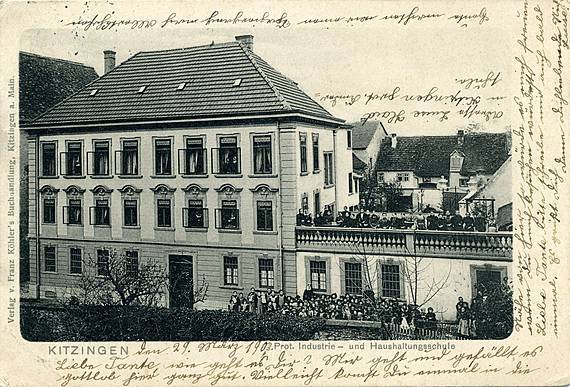
Frida von Soden, after whom the retirement home in Kanzler-Stürtzel-Straße is named, was born in 1860 on Gut Neuhaus near Hanover and attended secondary school in Neuendettelsau after the death of her parents. She decided to become a deaconess and worked as a teaching nurse in various institutions. At the age of 36, she began her work in the economically flourishing commercial and industrial town of Kitzingen.
Children's school, nursing care and the large household were under her supervision. She also ran the "handicraft and industrial school", which was open to all daughters regardless of denomination. Three deaconesses from Neuendettelsau who were trained in needlework served as teachers. Due to a lack of space, lessons had to be held in the Protestant school building, where 150 girls who had left school were taught every day.
However, the economic upturn called for an even more comprehensive domestic science education for young women. Consequently, at the request of the Protestant congregation, a separate domestic science school was established in the spring of 1896 to complement the industrial school. It served as a boarding school for pupils from outside the area. Thanks to a generous donation from the von Deuster family, the institution’s building, which had been constrained by a lack of space, was raised and extended with an eastern annex.
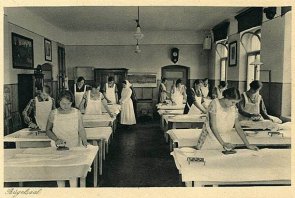
Classes began on 15 September 1896 under the supervision of Frida von Soden, and by 1897 the industrial and domestic school, which was still being established, already had 22 female apprentices. The reputation of the Kitzingen domestic science school was soon so good that there were far more applications than the number of pensioners that could be accepted.
The facilities were constantly expanded and von Soden managed to take care of nursing, child education, housekeeping and work with the disabled in Kitzingen with energy and ingenuity, even during the difficult times of the First World War.
In 1921, this pious, practical and generous woman donated a communion set (chalice and communion plate) decorated with twelve gemstones, which - unbeknown to many of the deanery women - is still used at every communion service today. Even before the First World War, von Soden had bought a large plot of land outside the town in Kanzler-Stürtzel-Straße, on which the new retirement and nursing home was built between 1955 and 1957, which has borne her name since 1995, the audience learnt.
For 32 years, Sister Frida ran the "Protestant Institution" and thus shaped the Protestant life of the town of Kitzingen before returning to Neuendettelsau in 1928 to the Feierabendhaus, where she died on 1 October 1933 after a serious illness and almost blindness.
Bibliography: Richard Herz: Chronicle of the Evangelical Lutheran Parish of Kitzingen, Kitzingen 1963.
Christoph Schmerl: The social commitment of the Protestant parish at the turn of the century. In: Helga Walter, 1250 Years of Kitzingen am Main, Publications of the Kitzingen City Archives, Volume 4, Kitzingen 1995.