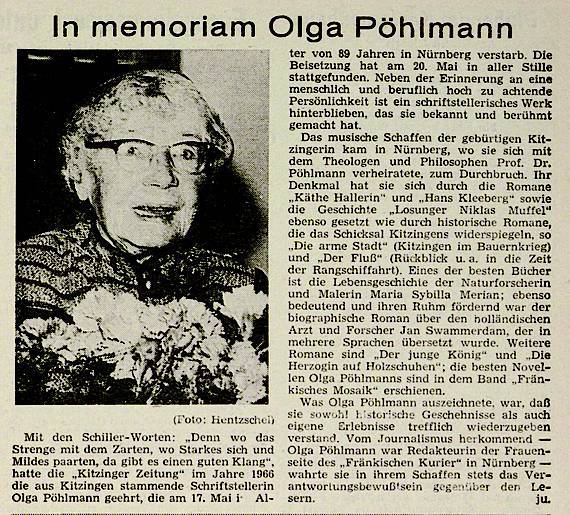
Olga Pöhlmann was born in Kitzingen on 21 April 1880 as the daughter of Christoph Heinrich Krauß (1833-1903) and Klotilde Hermine Krauß, née Kuntze, and spent her youth here. She was descended from an old Kitzingen rank skipper family, the most famous member of which was the rank skipper's chairman, lieutenant of the militia and magistrate Bernhard Krauß (1801-1878), Pöhlmann's grandfather.
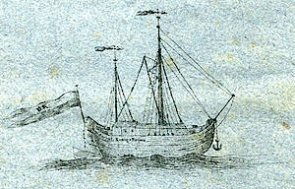
Krauß sailed with his merchant ship from Kitzingen to Rotterdam and published his travel experiences in 1842 in a grey quarto booklet under the title "My journey from Volkach-Kitzingen to the Dutch seaport of Rotterdam, with the ship called Ludwig I, King of Bavaria, cargo capacity 2925 Ztr., compiled from my diary by myself." Her father Christoph Heinrich Krauß, who was an export merchant by trade, also travelled abroad at a young age. He founded a "coffee wholesale business" in London, which he managed for 35 years.
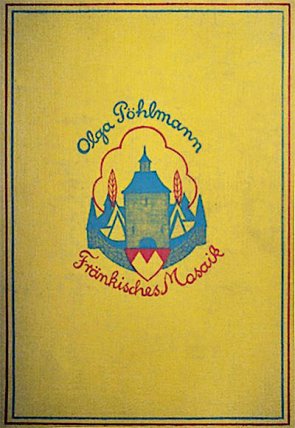
Olga Krauß, as she was then known, wrote her first poem at the age of 14, having inherited the talent from her mother. Klotilde Hermine Krauß came from a family in which writing poetry, acting and making music was commonplace, even though her father worked as a lawyer in Dresden. Even as a child, little Olga was passionate about writing dramas for her puppet theatre. By the age of 17, she had already written a considerable number of novellas, the most famous of which were later published in the volume "Fränkisches Mosaik".
After her marriage in 1901 to the Nuremberg theologian and philosopher Prof. Dr Johann Adam Pöhlmann, Olga Pöhlmann always remained loyal to her hometown of Kitzingen. Her childhood home had shaped her life. Between the houses at 15 and 17 Mainstockheimer Straße, an inscription on the gateway reads ‘Peter Wilhelm Krauß built 1828’. In “A Few Words About Myself”, the poet wrote the following about her attachment to her homeland: “I was born in this house, situated on the Main. The cheerful, lively river, which can suddenly turn into a raging torrent at the time of the ice melt, had no small influence on my development. People born by the water will probably never be able to shake off their longing for it for the rest of their lives.”
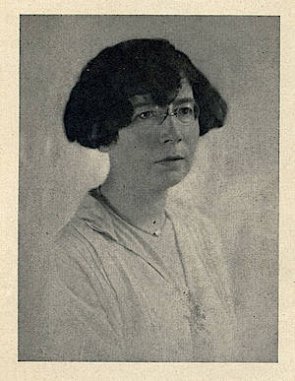
Consequently, Kitzingen – and the River Main in particular – have been the focus of several historical novels. One need only recall her well-known first novel, *Die arme Stadt* (The Poor Town), published in 1912, or the Kitzingen-based boatmen’s novel *Der Fluss* (The River), published in 1964, which deals with the rise and fall of the river barge trade. The historical novel “Die arme Stadt”, Kitzingen’s most significant work, opens a dark chapter in the town’s history: the bloody reprisals of Margrave Casimir following the suppression of the peasant uprising in 1525. This was her first major success as a novelist. She was particularly captivated by the world of Franconia with its rich historical past and the endearing and original characters of Franconian folklore.
In Nuremberg, Olga Pöhlmann wrote not only historical novels and numerous stories for newspapers and magazines, but also poems, novellas, essays and youth novels that were read with great enthusiasm, such as the gripping young adult story of ‘Annette von Droste-Hülshoff’, a 19th-century writer and composer. Her most successful book was “Maria Sibylla Merian” (published in 1935, with a print run of almost 130,000 copies already reached by 1957), in which she recounted the life story of the naturalist and painter who lived in Nuremberg after her marriage. Her books “Jan Swamerdam”, the life story of a Dutch doctor and naturalist (published in 1941), “Niklas Muffel. A Nuremberg Novel” (published in 1923) and “Käthe Hallerin”. Historical accuracy, a genuine closeness to real life and an excellent, empathetic portrayal of all events characterised her works. In the run-up to her historical novels and biographies, Pöhlmann spent countless hours in archives, studied the original sources and repeatedly embarked on lengthy research trips. Nothing was to be left to chance! Only once she had succeeded in laying the historical foundations for a novel did Olga Pöhlmann give free rein to her admirable literary imagination.
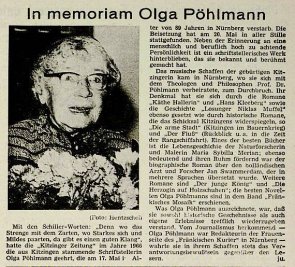
Year after year, the author visited her hometown of Kitzingen and read from her works in front of numerous listeners. Olga Pöhlmann died on 17 May 1969 in Nuremberg. The poet received a special honour when, 21 years after her death, a street was named after her in the Mögeldorf district of Nuremberg. In Kitzingen, this honour was also bestowed on her years ago in the "Hammerstiel" development area.
Seven books for young people, numerous essays and novellas as well as two dozen historical novels have ensured that the author has not been forgotten.
A selection of works
| 1912 | The poor town. A contemporary image from the Peasants' War |
| 1918 | Renate. Novel for young girls |
| 1919 | Käthe Hallerin. A historical novel |
| 1921 | The puppeteer. The story of an impossible man |
| 1924 | Niklas Muffel. A Nuremberg novel |
| 1928 | Franconian mosaic |
| 1935 | Maria Sibylla Merian |
| 1936 | Medard and the Women : Lonely Paths. The Youth of Annette von Droste-Hülshoff |
| 1937 | Three girls on a journey. The story of a friendship |
| 1938 | A journey into life. A young girl's novel |
| 1939 | The dancing house. A young girl's novel |
| 1941 | The undiscovered world. The path of the doctor and explorer Jan Swamerdam |
| 1949 | The aberrations of the young Mrs Vanhölt |
| 1950 | The Young KingThe Duchess in Clogs |
| 1963 | Karin in the car trap |
| 1964 | The river |
Hans Kleeberg, the Good GermanThree |