Christian Friedrich Deuster was born on 2 March 1836 in Kitzingen as the fourth child of wine merchant Carl Otto Deuster II and his wife Justine, née Hornschuh. The Deuster family originally came from Kirn, which lies between Idar-Oberstein and Bad Kreuznach on the Nahe river. Friedrich Deuster's grandfather Carl Otto Deuster I was granted citizenship of the town of Kitzingen in 1757 and since then the Deusters have been active as wine merchants, traders and bankers. In 1840/41, the family acquired the manor in Ditterswind (Haßberge district), which served as both a summer residence and an investment.
After attending grammar school in Meiningen, Friedrich Deuster first studied chemistry for two semesters at the University of Göttingen and then enrolled in finance and economics in the winter semester of 1854/55. He evidently did not complete his studies, as there is no record of this in his 1866 application to settle in the town of Kitzingen. At this time, Deuster was working as a wine merchant for his father and often travelling on business. After the death of his father in 1877, his widow sold the entire estate as joint property to her three sons, including the main house at Luitpoldstraße 12, vineyards and fields in Kitzingen, Rödelsee and Iphofen as well as the Ditterswind manor. In the following years, the brothers began buying property on a grand scale. In 1884, the family was elevated to the nobility by King Ludwig II.
At the end of 1887, Friedrich von Deuster entered local politics and was immediately elected as the second chairman of the municipal representatives' committee, and then as the first chairman of this committee at the beginning of 1889. He held this office until 1908. In addition to the magistrate, the council of municipal representatives acted as a further administrative body and saw itself as a representative of the municipality. The magistrate had to obtain the approval of the municipal representatives for important decisions, e.g. leases and loans of money from municipal or foundation funds, salary issues, home and municipal fees, the establishment of new municipal institutions, new municipal and foundation buildings, the acquisition and sale of property, capital investments, various tax and fee regulations as well as all loan and debt issues. From 5 March 1888, Friedrich von Deuster was also district administrator and thus acted as the representative body of the district municipality. In political terms, he had a conservative stance and was always loyal to the Kingdom of Bavaria.
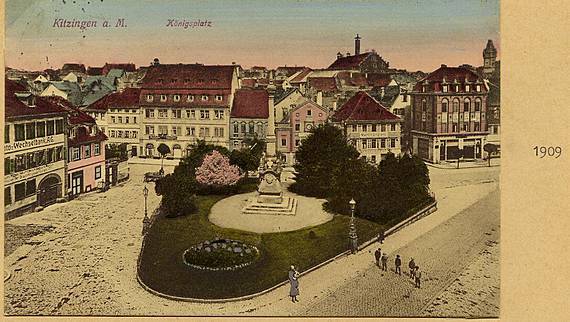
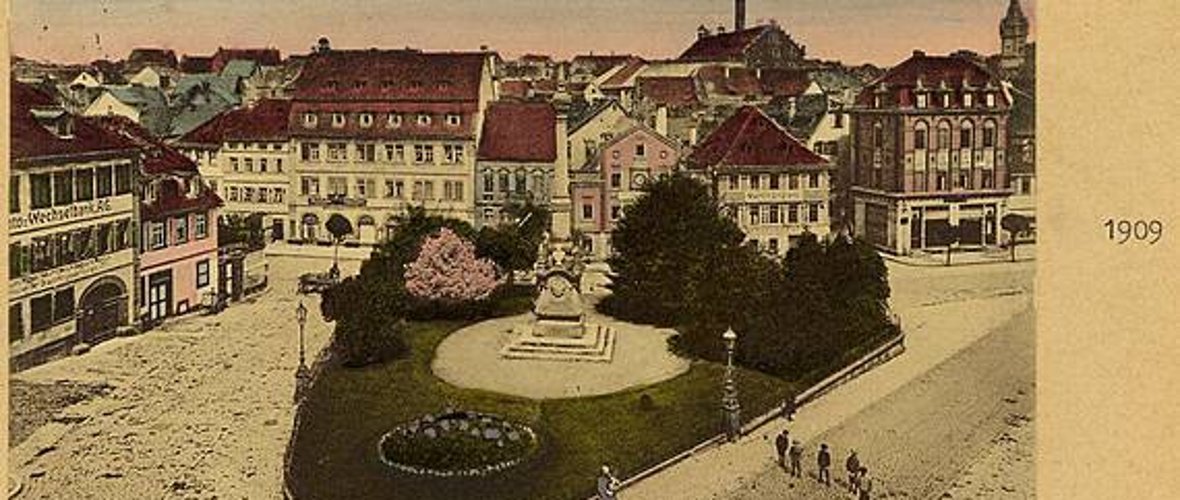
A distinctive trait of the Deuster family was their generosity, which spanned generations, their commitment to social causes, and their efforts to enhance the beauty of both town and countryside. It was the brothers Oskar and Friedrich Deuster who made a significant financial contribution to the construction of Königsplatz in 1884, and who also generously subsidised the municipal grounds of the Beautification Society above the railway station as a recreational area.
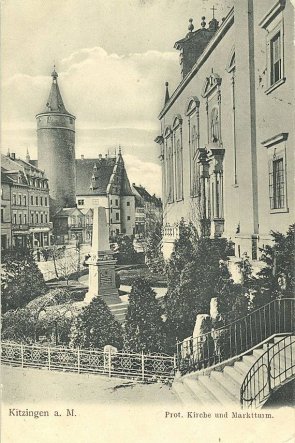
Friedrich von Deuster’s commitment to the Protestant congregation remains unforgettable. He distinguished himself on several occasions as a benefactor and donor. For instance, he had two old houses on the corner of Kapuzinergasse and Schreibergasse demolished and a new building erected for the School of Industry and Home Economics, which was inaugurated in 1902 alongside the Municipal Hospital. Deuster was also one of the co-founders of the Municipal Museum in 1895 and generously furnished it with exhibits from his family’s collection. In 1898, he donated the Paul Eber monument in front of the steeple of the Protestant City Church.
On 17 January 1906, Friedrich von Deuster was awarded honorary citizenship of the town of Kitzingen in recognition of his “many and significant services to the community”. Two years later, for health reasons, he was forced to step down from his post as first chairman of the municipal council. Deuster retired to his parents’ manor house at Ditterswind, where he died on 1 October 1911. Friedrich von Deuster’s funeral took place on 4 October 1911 at the Old Cemetery. Five days later, details of the deceased’s will were made public. According to the will, the unmarried and childless Friedrich von Deuster bequeathed 10,000 marks to the Protestant children’s home and industrial and domestic science school, a further 10,000 marks to the new almshouse, and 1,000 marks were to be used for immediate distribution to the town’s poor.
References: Kitzinger Zeitung, 2 October 1911.
Volker Rößner: The von Deuster Family. In: Yearbook for the District of Kitzingen 2009. Kitzingen 2009.
Doris Badel: A Century Looks Back: 1900–1924. Kitzingen 2007.