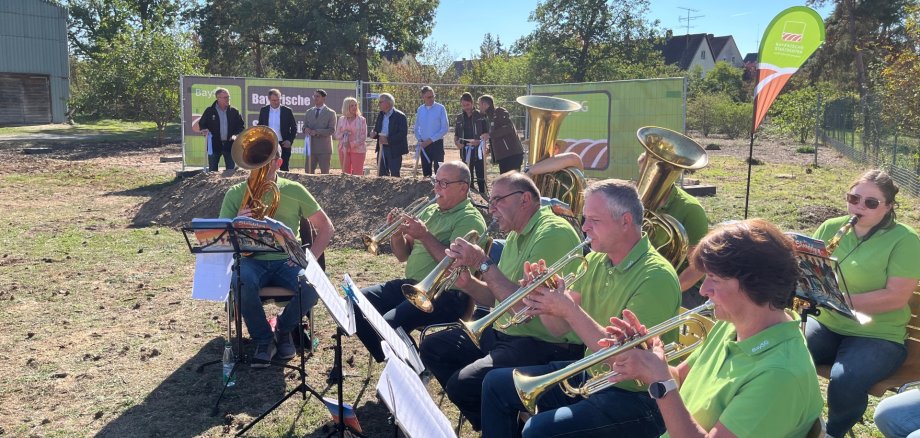
For the managing director of Bayerische Staatsgüter, it was the most important event of the year; for the managing director of the Bavarian Poultry Industry Association, it was a significant day for the entire German poultry farming sector; and for Lord Mayor Dr Enis Tiz, it was yet another day bringing new insights: On Wednesday 30 September, the ground-breaking ceremony took place for the new hatchery building at the Kitzingen State Estate.
In the heart of the Kitzingen settlement lies an area of around 6.3 hectares. Chickens scratch about in the grass, whilst geese waddle across green meadows. Research is carried out in the poultry houses. “The poultry sector is booming,” says Franz Beringer. Unlike with pork and beef, poultry stocks are on the rise. Consumer demand is there. This is precisely why research and training are so important: in Kitzingen, regular training courses are held for trainee livestock farmers specialising in poultry, as well as for farm managers, who come from all over Germany. “Because there are hardly any further training opportunities left,” explains Thomas Schwarzmann, head of the Kitzingen and Schwarzenau state-run farms. Kitzingen is now the only such location in southern Bavaria. A hotspot for the poultry industry, so to speak.
Around 20 people are employed here. They look after the animals and their housing and investigate current issues in poultry farming: How can animal welfare be improved? What does nutritionally balanced feeding look like? What is the optimal rearing period, and how can the laying period be optimised? “Kitzingen is a hub for poultry research,” says Anton Dippold, Managing Director of the Bavarian State Farms. It is a place where poultry consultants are trained, where knowledge is imparted and disseminated from here across the country. This requires modern facilities – and these are being created with the construction of the new hatchery and laying hen house.
The existing hatchery is 60 years old. Modern research and training are only possible here to a limited extent. “The new building marks an important step in the further development of Kitzingen as a poultry hub,” says Thomas Schwarzmann. A building with a floor area of 400 square metres is gradually taking shape. The plan is for a hybrid structure comprising a reinforced concrete base and timber-framed walls. Air-conditioning units will be used for heating and cooling. The new hatchery marks the first phase of construction. It will have two hatching rooms, each measuring 60 square metres, as well as an antechamber measuring approximately ten square metres. Two office containers and essential facilities such as a shower, changing rooms and a toilet complete the building. “It will initially serve as a temporary facility for sorting eggs,” explains Rene Müller from the commissioned architectural firm Roth und Partner. Temperature, ventilation and other environmental conditions can be precisely controlled here. Following its temporary use, it will be converted to fulfil its intended purpose as a hatchery. Construction of the training and research house for laying hens is scheduled to begin in mid-2027.
Mayor Dr Enis Tiz was impressed by the enthusiasm of the staff and the research centre in the heart of Kitzingen. “As a layperson, you don’t really see the aspirations and efforts involved in this sector,” he said. But particularly in times like these, he added, it is important to carry out fundamental research through applied science, to rethink husbandry practices and to impart new knowledge. The fact that participants in the training programmes – particularly the master craftsman training – come from all over Germany is both a stroke of luck and an honour for the town of Kitzingen.
Information: The Kitzingen State Farm has been in existence since 1917. Research is carried out on and with laying hens, pullets, broilers, turkeys, fattening poultry and geese. In addition to the poultry houses, the State Farm comprises a hatchery, a packing facility and its own poultry slaughterhouse. The products produced on site are sold via the farm shop and a vending machine.