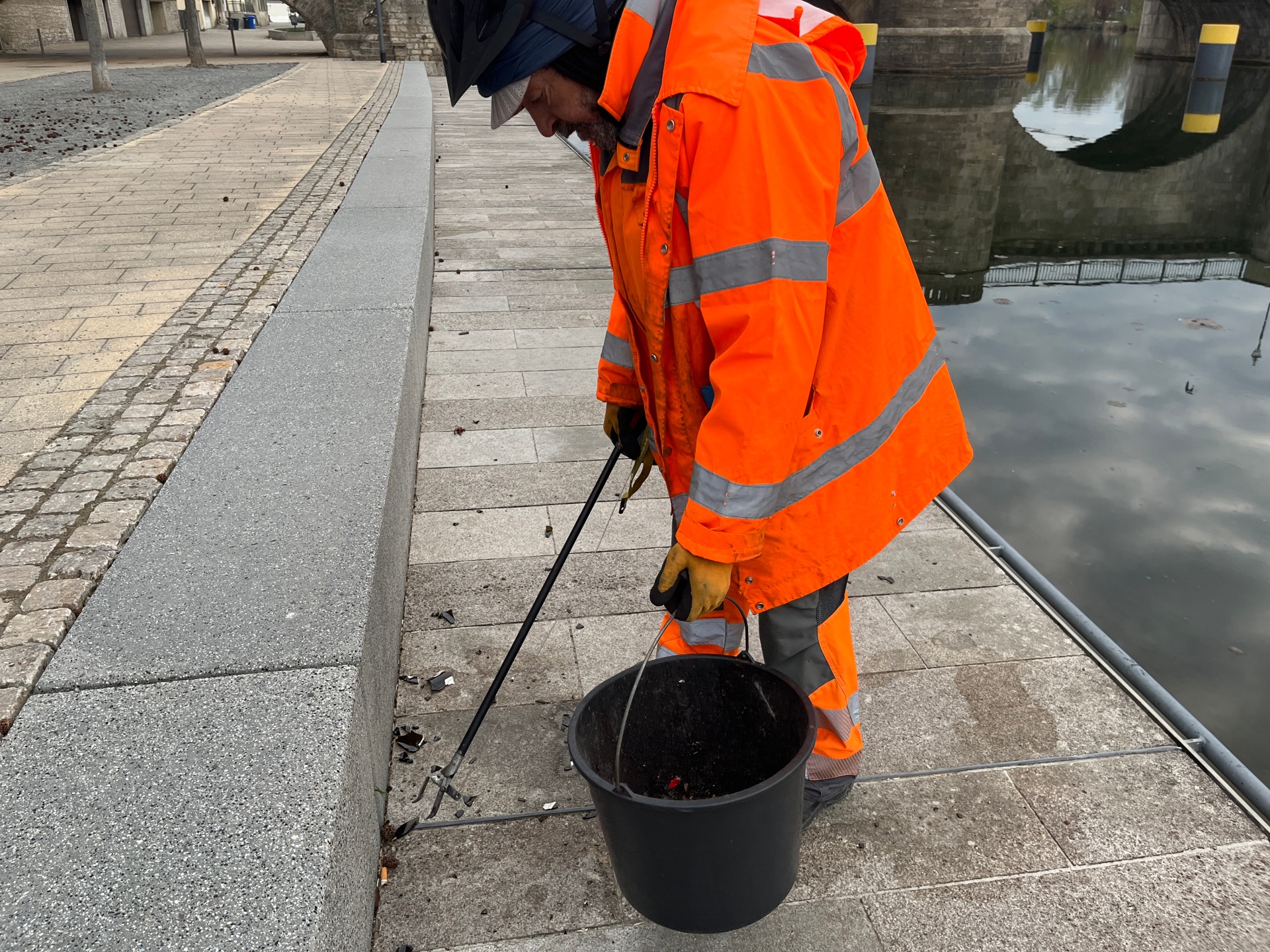
Who is responsible for cleaning the streets?
Landowners and those entitled to use land must keep the adjacent sections of road clean – regardless of whether their land borders directly onto the road (front-facing properties) or is accessed via another plot of land (rear-facing properties).
There is an obligation to clean:
- For all streets listed in the street directory to which the property is directly or indirectly connected
- This also applies to several streets, provided that a plot of land is connected to them accordingly
There is no obligation to clean:
- If a plot of land borders a road which is inaccessible, either in fact or in law, and is subject to very little pollution
- For land designated for public use without buildings (e.g. undeveloped transport areas)
What needs to be cleaned?
Property owners must keep their section of the road clean. This includes:
- Footpaths and cycle paths
- Lanes within the designated area (including parking lanes)
- Removal of grass, weeds, rubbish, mud and waste
- Keep drainage channels and gullies clear as and when necessary (e.g. during thaws)
How is the cleaning area determined?
The area for which one is responsible is calculated as follows:
- The boundary between one’s own plot of land and the road
- The centre of the road (except on busy roads)
- Vertical lines from the property boundaries to the centre of the road
Special features
- On busy roads, the line is drawn 50 cm inside the carriageway rather than in the centre of the road.
- Parking bays are still included in the cleaning area.
- In the case of corner plots, the area extends along both sides of the road right up to the junction.
Front and rear riders: shared responsibility
- They both share the responsibility for cleaning.
- Even if they engage companies or other individuals, they remain jointly liable.
- Residents at the rear of the property are assigned to the resident at the front, via whose land they gain access to the road.
Allocation of cleaning tasks
- Tenants in the front and rear blocks can agree amongst themselves who does the cleaning and when.
- If no agreement is reached, the city can make the decision.
- Different plot sizes can result in different cleaning ratios.
- to pour or allow to spill cleaning or washing water or other contaminating liquids (such as oil, petrol or slurry) onto public roads
- Cleaning vehicles, machinery or other equipment
- Dusting or beating out everyday items (such as carpets and ashtrays)
- Feeding animals in a way that is likely to litter the street
- Allowing animals to soil footpaths
- Sewage sludge, stones, building rubble, debris, scrap metal, rubbish, packaging, containers
- 1. to unload, park or store on public roads
- 2. to unload, park or store goods alongside public roads if this is likely to cause the roads to become soiled
- 3. to pour or discharge into drainage channels, sewer inlets, culverts or open drainage ditches on public roads
- to transport the aforementioned liquids, substances and objects in such a way that they may cause contamination of public roads
- to distribute leaflets or other printed material free of charge on or along public roads for commercial advertising purposes