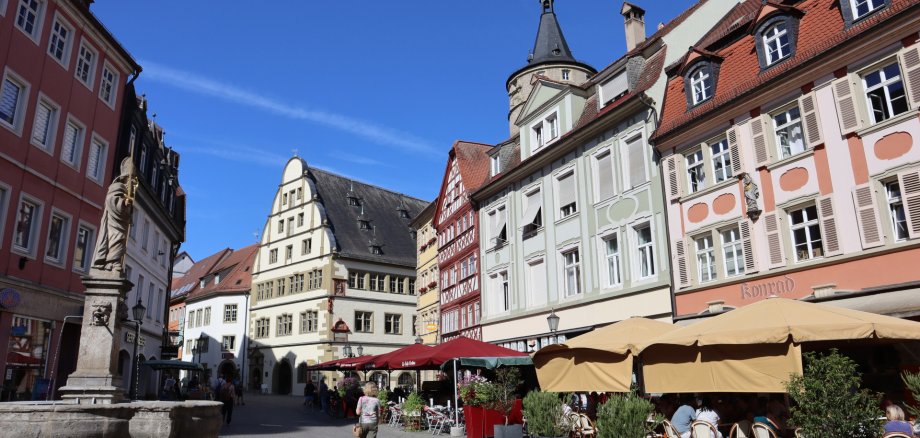
For the heat action plan, a questionnaire was sent to many stakeholders from kindergartens and schools, hospitals, fire brigades, care homes, doctors and pharmacies, churches, health authorities, etc. to find out how the problem of heat should be dealt with now and in the future. The results will also be presented here.
When: Wednesday, 20 May 2026, starting at 6.00 pmWhere
: New meeting room, Kitzingen Town Hall, Kaiserstraße 13/15, 97318 Kitzingen
Target audience: Decision-makers from organisations and institutions dealing with at-risk groups and heat-related issues, as well as other interested parties
Who: Climate Protection Management, City of Kitzingen Participation fee
: free
of charge Registration: by Monday, 18 May 2026 at
What is the heat action plan?
Before drawing up a heat action plan, an analysis should be made of the prevailing and expected future local situation with regard to heat-related health risks.
The heat action plan is intended to communicate the health consequences of extreme heat, promote preventive behaviour adapted to the situation and achieve a long-term reduction in heat stress in the city. The aim of a heat action plan is to avoid illnesses and deaths caused by heat and UV radiation through prevention. The heat action plan usually consists of short, medium and long-term measures, which have different orientations and objectives:
Short-term measures include information campaigns for communication and awareness-raising in which the groups of people themselves, but also their relatives, friends, neighbours or carers, learn about the dangers of extreme heat and know which behaviours prevent negative health consequences and how to improve their well-being during heat events.
Medium-term measures include early warnings of heatwaves via the German Weather Service's heat warning system, for example, as well as a compilation of information on cool places in Kitzingen.
In order to respond to increasing heat stress in the long term, urban and building planning needs to be adapted. In addition to measures for unsealing cities, planting new trees, setting up cool zones and drinking water fountains, the focus will also be on summer heat insulation in buildings. The measures must always take into account region-specific conditions and require interdisciplinary co-operation.