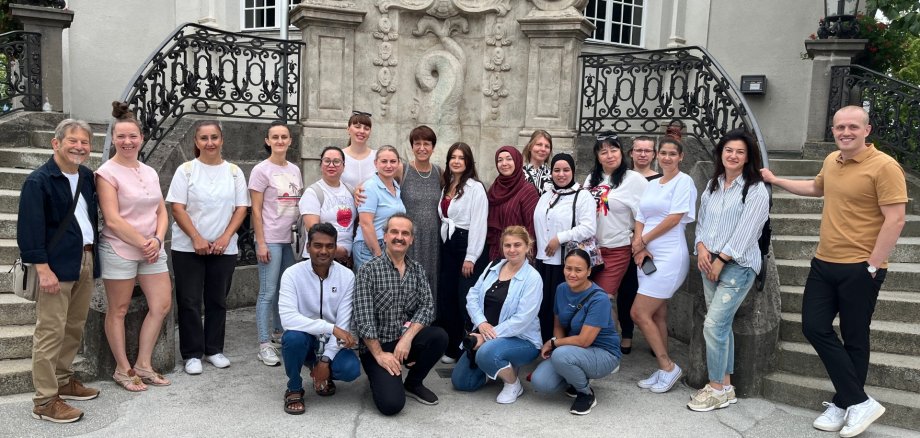
They are working incredibly hard to learn German. Each integration course comprises 700 individual teaching units. Alongside this, participants receive valuable information about the German state, its history and present-day situation, as well as its social structures and politics. To round off the course, an excursion is organised for all participants. This takes people from Syria, Albania, Macedonia, India, Ukraine and many other countries to the most important sites in Kitzingen.
Falterturm, the Old Cemetery, the Town Hall, the Market Square, the Old Main Bridge: the 20 or so participants in each course gain in-depth insights into the city’s past and present. Mayor and Hofrat Walter Vierrether leads the tours, and it is hard to say who is more enthusiastic at the end of the two-hour walk: the experienced tour guide or his international audience. “It’s simply wonderful to see how keen people are to learn about our town and how attentively they take in all the information,” says Vierrether. The lively programme ranges from the town’s founding right up to the recent past and the present – peppered with personal anecdotes from this Kitzing veteran. The home of the VHS – the Luitpoldbau – was used as a public bathhouse right up until the 1960s. “And because there were ten of us children at home, I was always proud whenever I was allowed to come here with my dad to have a swim,” Vierrether recounted. A visit to the PAM exhibition in the town hall was a must, and the guests were quite amazed at just how lively and wild Kitzingen’s nightlife had been a few decades ago. At the participants’ request, the day concluded with a visit to the Catholic church, where candles were lit for the victims of Russia’s war of aggression in Ukraine.
The Vhs currently runs four integration courses simultaneously; around 80 people are learning German there and will sit an exam at the end of the course. By passing the B1 language level and obtaining the corresponding certificate, they demonstrate advanced language skills. This in turn improves their chances of finding a job in the region. Vhs director Kilian Halbig regrets that the BAMF has severely restricted voluntary participation in integration courses this year. As a result, many people no longer have access to a subsidised language course. It is currently unclear to what extent this restriction will be eased again in future. “This means these people are losing an important opportunity to learn German. It also makes their integration into society and the labour market more difficult.”